
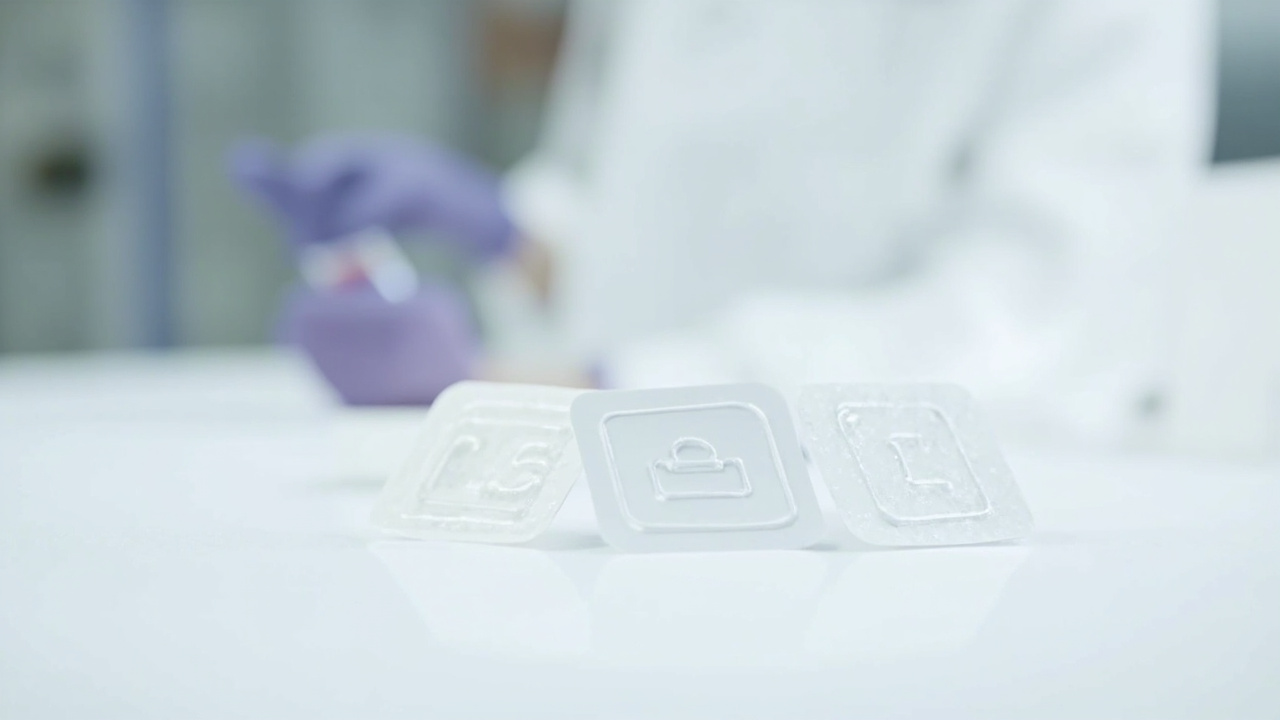
Transdermal patches are among the most moisture-sensitive pharmaceutical dosage forms in commercial production. A transdermal system is a thin, multi-layer laminate of pressure-sensitive adhesive, drug reservoir, backing film, and release liner — and each of those layers can absorb ambient water vapor, plasticize, delaminate, or degrade the active pharmaceutical ingredient (API) long before the patient ever opens the sachet. That is why desiccant patch packaging and well-engineered moisture barrier pouch systems are not afterthoughts in the supply chain; they are critical quality attributes of the product itself. For OEM buyers sourcing patches from contract manufacturers, understanding how humidity control patch design works — and how to specify it correctly — is the difference between a stable, shelf-life-compliant product and a costly recall.
In this guide, Kongdy Health’s packaging engineers break down the science of moisture ingress, the material economics of desiccants and barrier films, the regulatory expectations under FDA, ISO 13485, GMP, and CE frameworks, and the practical specification checklist that OEM buyers should use when qualifying a transdermal patch supplier.
Key Takeaways
- Why Transdermal Patches Are Exceptionally Moisture-Sensitive
- The Science of Moisture Ingress: WVTR, Headspace, and Residual Moisture
- Moisture Barrier Pouch Materials: A Comparative Guide
- Desiccant Selection: Silica Gel, Molecular Sieve, and Clay
- Regulatory and Quality Requirements for Humidity Control Patch Packaging
- A Step-by-Step Qualification Process for OEM Buyers
Key Takeaways
- Water vapor transmission rate (WVTR) of the pouch — not desiccant quantity alone — is the single most important design variable in humidity control patch packaging.
- Residual moisture in the patch adhesive and liner, not just headspace humidity, drives API degradation and adhesion loss; both must be controlled.
- Aluminum foil laminates typically deliver WVTR below 0.01 g/m²/day, while metallized PET structures are an order of magnitude higher — material choice has direct shelf-life consequences.
- Regulatory frameworks (FDA 21 CFR 211, ISO 13485:2016, EU GMP Annex 1) require documented moisture-control validation, not just a desiccant sachet dropped into a pouch.
- Accelerated stability testing at 40°C/75% RH is the standard method for validating desiccant patch packaging performance before commercial launch.
- Kongdy Health has engineered moisture-control packaging for transdermal programs since 1989 across 120+ countries, with FDA-registered, ISO 13485-certified facilities.
Why Transdermal Patches Are Exceptionally Moisture-Sensitive
To understand why desiccant patch packaging matters so much, you have to look at what a patch actually is at the materials level. A typical matrix-type transdermal system contains a drug-in-adhesive layer of 50–150 µm thickness, a polyester or polyethylene backing film, and a silicone or fluoropolymer-coated release liner. The adhesive is usually a polyacrylate or polyisobutylene blend that is hygroscopic by nature; when it absorbs water, its glass transition temperature drops, tack increases unpredictably, and cold flow accelerates. The result is adhesive transfer to the liner, edge curl, and inconsistent drug delivery — failures that show up in stability chambers months after release.
The API itself is often the more fragile component. Many small-molecule drugs used in transdermal delivery — nicotine, scopolamine, estradiol, fentanyl, rotigotine, rivastigmine — undergo hydrolysis, oxidation, or polymorphic conversion in the presence of moisture. Even a 0.5% weight gain in the adhesive layer can shift assay values outside the ±5% specification window required by most pharmacopeial monographs. Industry stability data presented at controlled-release delivery conferences (2022–2023) consistently show that moisture-related degradation is among the top three root causes of out-of-specification results in transdermal products.
There is also a physical dimension that is frequently underestimated: dimensional stability. Backing films and liners expand and contract with humidity changes at different rates, creating differential stress across the laminate. Over a 24-month shelf life, this can produce wrinkling, tunneling, and delamination visible to the patient — a cosmetic defect that regulators treat as a quality defect. A properly specified moisture barrier pouch with the right desiccant load stabilizes the internal microclimate and prevents these mechanical failures.
The Science of Moisture Ingress: WVTR, Headspace, and Residual Moisture
Moisture control in patch packaging operates on three fronts, and confusing them is one of the most common specification errors we see in OEM inquiries. The first front is moisture ingress — water vapor migrating through the pouch wall over time, quantified by water vapor transmission rate (WVTR) in g/m²/day at defined temperature and relative humidity. The second is headspace humidity — the water vapor already trapped inside the pouch at the moment of sealing. The third is residual moisture — water bound within the patch laminate itself, which desiccants in the headspace cannot easily remove because it is diffusion-limited through the adhesive matrix.
A desiccant sachet addresses headspace humidity and absorbs the slow ingress that passes through the pouch. It cannot fix a patch that was manufactured or stored at high humidity before packaging, nor can it compensate for a pouch with poor barrier properties. This is why GMP-compliant manufacturing under ISO 13485 requires control of the packaging environment itself — typically a controlled low-humidity room at 20–30% RH — before the patch ever meets its pouch. At Kongdy Health, coating, lamination, and packaging occur in humidity-controlled cleanrooms so that the desiccant is managing a small, predictable moisture load rather than a large one.
The math is straightforward but often ignored. A pouch with an internal surface area of 0.02 m², a WVTR of 0.05 g/m²/day, and a 24-month shelf life will admit roughly 0.73 g of water vapor under accelerated conditions — more than a typical 1 g silica gel sachet can absorb while maintaining the low internal RH needed for API stability. Reducing WVTR to 0.005 g/m²/day cuts that load by 90% and allows a smaller, cheaper desiccant. Barrier performance is therefore the highest-leverage design decision in the entire humidity control patch system.
Moisture Barrier Pouch Materials: A Comparative Guide
Selecting the right moisture barrier pouch structure is a trade-off among barrier performance, mechanical strength, cost, and sustainability profile. The table below summarizes the performance tiers we routinely specify for transdermal OEM programs.
- Aluminum foil laminate (e.g., PET/Alu/PE or PET/Alu/PET/PE): WVTR typically below 0.01 g/m²/day; near-absolute moisture and light barrier; the gold standard for humidity control patch packaging of hydrolysis-prone APIs. Higher cost and lower flex-crack resistance than metallized films.
- Metallized PET laminate (PET/MPET/PE): WVTR in the 0.1–0.5 g/m²/day range; good light barrier; lower cost; suitable for robust APIs with shorter shelf lives or for secondary packaging.
- High-barrier clear films (PET/PCTFE or PET/EVOH/PE): WVTR around 0.1–1 g/m²/day depending on structure; transparent for product inspection; EVOH barrier degrades at high humidity, so it must be buried in the laminate.
- Coextruded PE or PET/PE structures: WVTR above 1 g/m²/day; generally insufficient as a primary moisture barrier for transdermal patches unless paired with a robust desiccant system and short shelf life.
- Child-resistant and senior-friendly (CRSF) formats: often use foil laminates with tear notches or peelable seals; barrier performance must be re-validated because seal geometry affects ingress paths.
Beyond the film itself, seal integrity is the silent failure mode. A pouch with excellent film but a channel leak at the fin seal will fail stability testing every time. Dye penetration testing (ASTM F1929), bubble emission testing (ASTM F2096), and seal strength testing (ASTM F88) should be part of routine quality control, and the results documented under the device or drug master file. For OEM buyers, requesting seal integrity data alongside WVTR certificates is a fast way to separate serious manufacturers from assemblers.
Desiccant Selection: Silica Gel, Molecular Sieve, and Clay
Desiccants are not interchangeable commodities. The three families used in pharmaceutical patch packaging have distinct adsorption isotherms, capacities, and regulatory profiles, and the right choice depends on the target internal RH, the pouch volume, and the API’s sensitivity threshold.
Silica gel is the workhorse. It adsorbs up to roughly 35–40% of its own weight in water at 80% RH and maintains low RH at partial loading, which is exactly what patch stability requires. Pharmaceutical-grade silica gel in Tyvek or paper sachets is well characterized, inexpensive, and widely accepted by regulators. Molecular sieve (zeolite) offers higher capacity at very low RH and superior performance at elevated temperatures, making it attractive for products distributed in hot climates — but it is more expensive and can over-dry some adhesives, causing brittleness. Clay desiccants (montmorillonite) are the lowest-cost option but have lower capacity and a steeper isotherm, so they are typically reserved for secondary packaging or short-shelf-life products.
Canister and sachet formats also matter for patient safety and line speed. Sachets are flexible and low-cost but can be punctured; canisters are rigid and easier to inspect but bulkier. For high-speed patch packaging lines, desiccant canisters integrated into the cap or a desiccant-lined pouch wall can eliminate the loose-sachet handling step entirely. Whatever the format, the desiccant must be pharmaceutically acceptable, non-toxic if ingested (relevant for child-resistant packaging), and supported by a supplier certificate of analysis for adsorption capacity and dust level.
Regulatory and Quality Requirements for Humidity Control Patch Packaging
Humidity control in patch packaging sits at the intersection of drug GMP and device quality system requirements, because transdermal patches are regulated as combination products in most major markets. In the United States, 21 CFR Part 211 requires that packaging systems protect the product from foreseeable environmental factors, and FDA guidance on container closure systems expects documented moisture barrier performance and stability data. In Europe, EU GMP Annex 1 and the EMA guideline on quality of transdermal patches set analogous expectations, while CE marking under the Medical Device Regulation applies to patch-based devices such as analgesic or cosmetic systems.
ISO 13485:2016 provides the quality management framework that ties these requirements together: design controls for packaging selection, validation of packaging processes, supplier qualification for desiccant and film vendors, and change control when any material is substituted. A common audit finding is a packaging change — a new film supplier, a different desiccant gram weight — implemented without re-running stability. Buyers should confirm that their OEM partner has a formal change control procedure covering packaging materials and that accelerated and real-time stability studies are re-triggered by any change.
Documentation is where serious manufacturers differentiate themselves. A complete packaging validation package for a transdermal program should include WVTR test reports, seal integrity data, desiccant capacity certificates, extractables and leachables assessments for the film and adhesive interface, and stability data at ICH conditions (25°C/60% RH and 40°C/75% RH). Kongdy Health maintains these records across its FDA-registered, ISO 13485-certified, GMP-compliant facilities and supports customers through regulatory submissions in 120+ countries.
A Step-by-Step Qualification Process for OEM Buyers
When sourcing a transdermal patch program, humidity control should be qualified with the same rigor as the drug formulation. The following sequence is the one we recommend to OEM customers and use internally when onboarding a new patch product.
- Define the moisture sensitivity profile of the API and adhesive: establish the critical relative humidity threshold above which degradation or adhesion loss occurs, using preformulation data and forced-degradation studies.
- Calculate the moisture load budget: combine expected WVTR ingress over shelf life, headspace moisture at sealing, and residual laminate moisture to determine the total water the desiccant must absorb while holding internal RH below the threshold.
- Select the barrier structure: choose the lowest-WVTR film that meets cost, format, and sustainability targets — usually an aluminum foil laminate for hydrolysis-prone APIs.
- Size the desiccant: specify gram weight, isotherm type, and format (sachet, canister, or integrated liner) with a safety factor of at least 1.5× the calculated load.
- Validate the sealing process: establish seal temperature, pressure, and dwell windows; verify with ASTM F88 seal strength and ASTM F1929 dye penetration testing.
- Run accelerated stability: place packaged patches at 40°C/75% RH for 6 months and at 30°C/65% RH for 12 months, testing assay, related substances, adhesion, and appearance at each interval.
- Confirm real-time stability: initiate 24–36 month real-time studies at 25°C/60% RH to support the labeled shelf life, and link the data to the container closure system in the regulatory submission.
- Lock change control: document approved film, desiccant, and seal parameters in the quality agreement, and require re-validation before any substitution.
This process typically adds 8–14 weeks to a development timeline, but it prevents the far more expensive scenario of a stability failure after launch. In our experience, OEM buyers who front-load packaging qualification reduce late-stage reformulation risk substantially.
Market Context and Emerging Trends
The transdermal patch market was valued at roughly USD 8–9 billion in 2023 and is projected to grow at a compound annual growth rate of about 5–7% through 2030, according to market research published by Grand View Research and MarketsandMarkets in 2023–2024. Growth is driven by biologics-friendly microneedle formats, CNS and pain-management products, and hormone therapy — categories where moisture sensitivity is acute. As patch volumes rise, so does demand for high-barrier packaging: industry estimates suggest aluminum foil laminates already account for the majority of primary packaging in regulated transdermal markets.
Two trends are reshaping humidity control patch design. First, sustainability pressure is pushing brands toward thinner foil, mono-material PE structures, and recyclable high-barrier films — all of which require re-validation because barrier performance changes. Second, serialization and tamper-evidence requirements are adding layers and seals to pouches, creating new potential moisture ingress paths that must be tested. Manufacturers that can validate these new structures quickly will have a competitive advantage.
If you are developing or resourcing a transdermal patch program and need a partner with deep experience in desiccant patch packaging, barrier film selection, and regulatory documentation, explore Kongdy Health’s OEM/ODM services. With manufacturing experience since 1989, FDA registration, ISO 13485 certification, and GMP-compliant facilities serving 120+ countries, Kongdy Health can take your patch from formulation through validated, moisture-controlled commercial packaging.
Frequently Asked Questions
How much desiccant should be used in a transdermal patch pouch?
The correct desiccant quantity is calculated from the moisture load budget: WVTR ingress over shelf life plus headspace moisture plus residual laminate moisture, multiplied by a safety factor of at least 1.5×. In practice, most transdermal pouches use 0.5–2 g of pharmaceutical-grade silica gel, but the number should always be derived from the specific film, pouch size, and API sensitivity threshold. Oversizing desiccant wastes money and can over-dry adhesives; undersizing risks stability failure. A qualified OEM partner will provide the calculation and supporting accelerated stability data.
What WVTR should a moisture barrier pouch have for a 24-month patch shelf life?
For hydrolysis-prone APIs and a 24-month shelf life, we recommend a pouch with WVTR below 0.01 g/m²/day at 38°C/90% RH, which generally means an aluminum foil laminate structure. Metallized PET films at 0.1–0.5 g/m²/day can be acceptable for robust APIs with shorter shelf lives or with larger desiccant loads. The specification should always be validated against ICH accelerated stability data at 40°C/75% RH rather than assumed from the film datasheet alone, because seal quality and pouch geometry affect real-world performance.
Does humidity control patch packaging need to be validated under ISO 13485?
Yes. Under ISO 13485:2016, packaging is part of the product realization process and must be designed, validated, and change-controlled like any other critical process. For combination products, FDA 21 CFR Part 211 and EU GMP Annex 1 add requirements for container closure integrity and stability documentation. Buyers should request the packaging validation report, WVTR and seal integrity test data, and the change control procedure before approving a supplier. Kongdy Health maintains these records across its FDA-registered, ISO 13485-certified, GMP-compliant facilities.
Sources
- Grand View Research — Transdermal Patches Market Report
- MarketsandMarkets — Transdermal Patch Market
- U.S. FDA — Guidance Documents (Container Closure Systems)
- ISO 13485:2016 — Medical Devices Quality Management Systems