
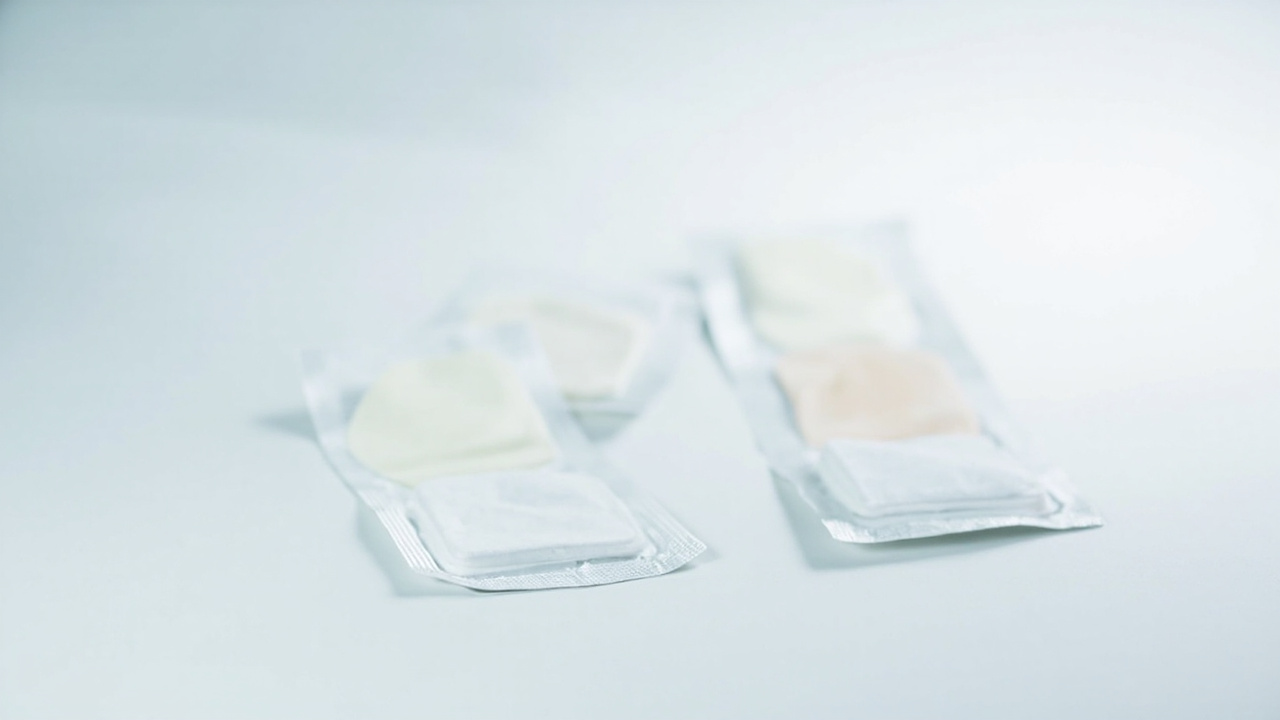
Migraine cooling strips have moved from niche pharmacy impulse buys to a core SKU in the global headache and pain-relief category. For brands and distributors sourcing a migraine cooling strip, the difference between a product that reorders and one that collects returns rarely comes down to marketing—it comes down to geometry, adhesive chemistry, and how the patch behaves on the curved, mobile, and often sensitive skin around the temples and forehead. This guide breaks down the engineering behind a high-performing forehead cooling patch, with the data and design checkpoints a serious headache patch OEM partner should be able to document.
The global migraine drugs and devices market has been estimated in the multi-billion-dollar range (Grand View Research, ~2023), and the over-the-counter topical cooling segment continues to expand as consumers look for drug-free, fast-onset comfort options. At the same time, regulatory expectations for transdermal and topical patch products have tightened across the US, EU, and Asia. Whether you are launching a private-label cooling strip or reformulating an existing line, the following sections cover the shape, adhesion, and fit variables that determine product performance and regulatory readiness.
Key Takeaways
- Why Shape Matters More Than Most Buyers Expect
- Adhesion Science: What Separates a Good Strip From a Great One
- Temple Fit: The Anatomy-Driven Design Challenge
- Cooling Performance: Materials, Testing and Claims
- A Step-by-Step OEM Development Roadmap
- Regulatory and Quality Checkpoints for Buyers
Key Takeaways
- Patch geometry—not just gel chemistry—drives perceived cooling performance; temple and forehead curvature require different cut profiles.
- Adhesion must be tested on skin under sweat, movement, and hairline conditions, not just on steel plates per standard peel tests.
- Temple fit depends on a tapered, low-profile edge that resists lifting during facial movement.
- Regulatory pathway (FDA, CE, ISO 13485, GMP) should be mapped before tooling, because claims and materials affect classification.
- An experienced OEM partner can shorten development by combining die-cut tooling, adhesive selection, and stability testing under one roof.
Why Shape Matters More Than Most Buyers Expect
Cooling strips work through evaporative and conductive heat transfer, but the consumer experience is dominated by contact area and pressure distribution. A patch that lifts at the corners loses contact, creates a warm air gap, and reads as “not working” within minutes. Research on wearable adhesives consistently shows that edge lift initiates at high-curvature zones—exactly where the forehead transitions to the temple and where the brow ridge creates compound curves. For a migraine cooling strip, the shape must therefore be designed around the anatomy of the frontal bone and temporal region rather than a generic rectangle.
In practice, OEM manufacturers evaluate at least three cut profiles: a full-width forehead band, a tapered temple-to-temple arc, and a compact temple strip for localized cooling. Each profile changes the peel force distribution. A wide band increases total adhesion but can wrinkle over the brow; a tapered arc follows the orbital rim and reduces lift; a compact temple strip concentrates cooling over the superficial temporal artery, which many users associate with faster relief. The right choice depends on your target user, packaging format, and claim strategy.
Die-cut tolerances also matter for manufacturing scale. A 0.5 mm variation in edge radius may seem trivial, but it affects how the release liner separates on high-speed lines and how the patch conforms in the package. Brands sourcing from an ISO 13485-certified facility should ask for the tooling drawing, tolerance stack-up, and a sample retention plan before committing to a production run.
Adhesion Science: What Separates a Good Strip From a Great One
Adhesion is where many cooling strip projects fail. Standardized peel tests (for example, 180-degree peel on stainless steel) provide a baseline, but they do not predict performance on skin that is sweating, moving, or covered with skincare residue. A credible headache patch OEM will run skin-simulated adhesion testing that includes artificial sebum, moisture, and repeated flex cycles. Hydrogel and hydrocolloid systems behave differently: hydrogels offer high initial tack and a cooling sensation but can lose cohesion under prolonged moisture, while hydrocolloids absorb moisture and maintain integrity longer but may feel less “cold” on application.
Adhesive selection also interacts with the active cooling mechanism. If the strip relies on menthol or a phase-change gel, the adhesive must remain compatible with the formulation over shelf life; plasticizer migration can soften the adhesive and cause residue. Stability testing at accelerated conditions (typically 40°C/75% RH for three to six months, depending on the market) is essential, and the data should be available for regulatory submission. Under FDA 21 CFR and EU MDR expectations, the manufacturer must be able to demonstrate that the product remains safe and effective through its labeled shelf life.
Finally, consider the removal experience. Migraine sufferers often have sensitive skin and may apply and remove a strip several times during an attack. A residue-free removal profile and a low-irritation adhesive are not optional—they are part of the product’s usability. Patch manufacturers should provide primary skin irritation and sensitization data, typically from HRIPT or comparable studies, as part of the technical file.
Temple Fit: The Anatomy-Driven Design Challenge
The temple is one of the most difficult areas to adhere a patch to because it combines thin skin, underlying vasculature, hairline proximity, and constant micro-movement from facial expression and jaw motion. A forehead cooling patch that extends to the temples must taper at the ends to avoid lifting. A uniform-thickness strip tends to peel from the inferior edge first, especially when the user lies down—a common behavior during a migraine. Tapered edges, a lower-profile backing film, and a slightly larger adhesive border than the cooling gel area all improve retention.
Fit also affects the cooling sensation itself. Users often report that a strip “feels colder” when it conforms closely, because conductive contact improves and evaporative airflow is directed across the skin rather than under a lifted edge. This is a perception issue with real commercial consequences: review data and repeat purchase rates correlate strongly with early sensory feedback. For OEM buyers, this means the brief should specify not only dimensions but also target conformability, edge thickness, and the intended application position.
Hairline and brow management deserve explicit design attention. A strip that overlaps eyebrows can pull hair on removal, while one that sits too high on the forehead may not reach the temple cooling zone users expect. Many successful products include a visual application guide on the pouch and a slightly asymmetric cut that follows the natural brow line. These details are inexpensive to add at the tooling stage and expensive to fix after launch.
Cooling Performance: Materials, Testing and Claims
Cooling performance is typically characterized by temperature drop over time, duration of effect, and subjective sensory rating. A well-designed strip may produce a measurable skin temperature reduction within the first few minutes and sustain a comfortable sensation for 30 to 60 minutes or longer, depending on formulation and ambient conditions. Brands should request time-temperature curves rather than a single “up to X hours” claim, because the curve reveals how quickly the effect fades and whether the claim is defensible.
Materials selection drives both performance and cost. Common options include water-based hydrogels with menthol or menthyl lactate, phase-change materials, and evaporative non-woven systems. Each has trade-offs in cooling intensity, duration, skin feel, and manufacturability. A capable OEM partner will present a matrix of options with sample data rather than a single formulation, allowing the brand to balance cost, sensory profile, and regulatory claims.
Claims language must match the evidence and the regulatory pathway. In the US, a product that only cools and soothes is generally regulated differently from one that makes drug-like therapeutic claims; in the EU, classification under MDR depends on intended purpose. Working with a manufacturer that maintains GMP and ISO 13485 systems, and that can support CE marking where applicable, reduces the risk of costly relabeling after launch.
A Step-by-Step OEM Development Roadmap
Bringing a cooling strip to market follows a predictable sequence, but the details determine speed and cost. The following roadmap reflects how an experienced manufacturer typically structures a project, from brief to shelf.
- Define the user and claim strategy. Specify target market, intended use, and claims so the regulatory pathway and testing plan can be set early.
- Select the patch format. Choose forehead band, tapered arc, or temple strip based on user research and packaging format.
- Lock the adhesive and cooling system. Evaluate hydrogel, hydrocolloid, and evaporative options against skin-simulated adhesion and time-temperature data.
- Tool the die-cut. Approve drawings, tolerances, and edge profiles; produce pilot samples for fit testing.
- Run stability and safety testing. Accelerated and real-time stability, plus irritation and sensitization studies, feed the technical file.
- Validate packaging and line trials. Confirm liner release, seal integrity, and shelf-life labeling on production equipment.
- Complete regulatory documentation. Assemble the technical file for FDA, CE, or local registration as required.
- Scale production and audit. Confirm capacity, batch records, and quality agreements before the first commercial run.
Each step should produce documented outputs. Buyers should expect a project timeline, a testing matrix, and a clear change-control process. The strongest OEM relationships function as an extension of the brand’s quality team, not just a supplier of die-cut rolls.
Regulatory and Quality Checkpoints for Buyers
Regulatory status is a frequent source of delay in patch projects. In the US, the FDA expects manufacturers of topical patch products to operate under current good manufacturing practice and to maintain appropriate device or drug documentation depending on classification. In the EU, the Medical Device Regulation (EU MDR 2017/745) requires a technical file, clinical evaluation, and post-market surveillance for CE-marked devices. ISO 13485 certification provides the quality management framework that underpins both pathways, and GMP compliance supports batch consistency and traceability.
When auditing a potential partner, request certificates with scope statements, not just logos. Confirm that the ISO 13485 scope covers the specific product type, and ask how the manufacturer handles supplier qualification for raw materials such as adhesives and backing films. Review sample batch records and deviation handling. These checks are routine for serious buyers and signal to the manufacturer that you understand the category.
Labeling is another checkpoint. Directions for use, warnings, storage conditions, and shelf-life statements must align with the testing data. For a migraine cooling strip, clear guidance on application position and removal reduces misuse complaints and supports a cleaner post-market surveillance record.
Market Context and Sourcing Strategy
The consumer health market continues to shift toward drug-free, portable relief products, and cooling strips fit that trend well. Industry analyses of the migraine and headache treatment space (MarketsandMarkets, ~2022–2023) point to sustained growth in non-pharmacological options, while e-commerce has lowered the barrier for new brands to test niche formats. This creates opportunity but also pressure on differentiation—shape, fit, and sensory experience are among the few levers a brand can control when formulations are similar.
Sourcing strategy should therefore prioritize partners with in-house tooling, adhesive expertise, and regulatory support. A manufacturer that can move from concept to pilot samples quickly, then scale to commercial volumes under ISO 13485 and GMP, reduces time-to-market and protects the brand if a claim or material needs adjustment. Kongdy Health has operated as a transdermal patch OEM/ODM manufacturer since 1989, serving more than 120 countries with FDA, ISO 13485, and GMP-aligned systems, and can support cooling patch development from geometry to regulatory documentation. To discuss a project, visit Kongdy Health’s OEM/ODM services.
Frequently Asked Questions
What shape works best for a migraine cooling strip?
There is no single best shape, but tapered arcs and temple strips generally outperform plain rectangles because they follow the curvature of the forehead and orbital rim, reducing edge lift. A full-width band can work for users who apply the strip while lying down, provided the edges are tapered and the adhesive border is adequate. The right choice depends on your target user, application instructions, and packaging format, so request fit samples across profiles before finalizing tooling.
How should adhesion be tested before launch?
Adhesion should be evaluated on skin-simulated substrates that include artificial sebum, moisture, and repeated flex cycles, in addition to standard peel tests on steel. Testing should cover initial tack, sustained adhesion over the intended wear time, and residue-free removal. Pair these results with irritation and sensitization data, and confirm that accelerated stability testing supports the labeled shelf life under your target market’s regulatory expectations.
What certifications should a headache patch OEM hold?
At minimum, look for ISO 13485 certification with a scope that covers topical patch manufacturing, plus evidence of GMP compliance. Depending on your market, you may also need CE marking support under EU MDR or documentation aligned with FDA expectations. Ask for certificates with scope statements, sample batch records, and a clear change-control process—these indicate a quality system that can support your technical file and post-market obligations.
Sources
- Grand View Research – Migraine Drugs Market Analysis
- MarketsandMarkets – Migraine Market Report
- U.S. Food and Drug Administration – Medical Devices
- ISO 13485:2016 – Medical Devices Quality Management
2 thoughts on “Migraine Cooling Strip: Shape, Adhesion & Temple Fit Guide”
Comments are closed.